


Best Sowing Season: February–April & June–July


- Choosing a selection results in a full page refresh.

Available 24/7 at
0300 110 7787
Pack Size: 20 seeds per pack.
Grow Bitter Gourd Long – Kareli Jhalri, a vigorous warm-season climbing vegetable producing long, dark-green fruits with distinctive deep ridges and the characteristic bitter flavour of traditional karela.
This productive summer vine grows strongly in warm weather and performs best when trained vertically on a trellis, net, fence or other strong climbing support.
Young green fruits are widely used in Pakistani cooking and are particularly suitable for karela salan, stuffed karela, fried karela, karela gosht and other traditional dishes.
Suitable for kitchen gardens, open soil, raised beds, rooftop gardens and large grow bags.
Germination Time: 7–10 days
Suitable Temperature: 25°C–35°C
Best Sowing Season: February–April & June–July
Couldn't load pickup availability
Free standard shipping on orders over RS 5000
Kareli Jhalri is a traditional long bitter gourd type recognized for its distinctive:
Plants develop long trailing vines that climb readily when suitable support is provided.
Fruit size, colour intensity, ridge development and final length may vary according to growing conditions, fertility, irrigation, temperature, pollination and harvesting stage.
For best eating quality, fruits should normally be harvested while:
Young, green and tender.
Young tender Kareli Jhalri fruits are particularly suitable for:
Harvesting fruits while they are still young and green generally provides the best:
Avoid allowing fruits intended for cooking to become fully mature and yellow.
G-12 Grow Bag – 12 × 12 inch 🔗
Suitable for one Bitter Gourd plant where space is limited and regular watering and feeding can be maintained.
A strong trellis must be installed separately.
G-20 F Grow Bag – 20 × 16 inch | 22 Gallon 🔗
Highly recommended for container-grown Bitter Gourd.
Its larger root volume provides improved moisture stability and growing space for vigorous summer vines.
G-24 Grow Bag – 24 × 12 inch | 23.5 Gallon 🔗
An excellent choice where a wider growing surface is preferred.
For strong long-term container production:
G-20 F or G-24 is recommended because vigorous climbing gourds benefit from generous soil volume, regular moisture and adequate nutrition.
Always provide a strong trellis beside the grow bag.
Use fertile, loose and well-drained soil rich in organic matter.
A practical GREEN GARDENS mix can be:
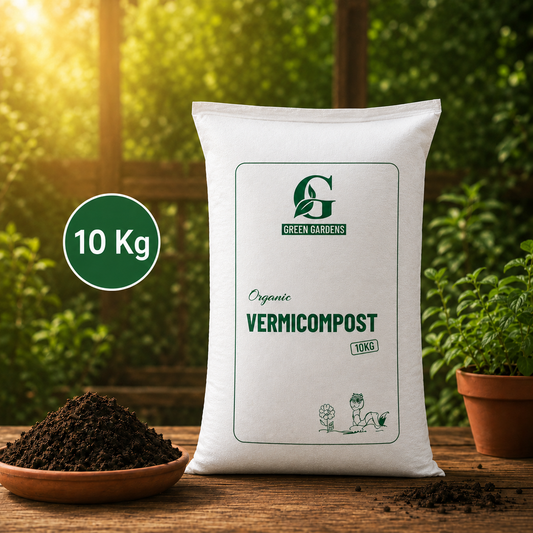
50% Bhalu Mitti (Sandy Soil) + 50% GREEN GARDENS Vermicompost 🔗
Bitter Gourd prefers:
A slightly acidic to neutral soil is generally suitable.
Avoid:
Good drainage becomes particularly important during monsoon sowing.
Bitter Gourd seeds have a comparatively hard seed coat.
For improved and more uniform germination, seeds may be soaked in clean water for approximately:
8–12 hours before sowing.
Do not leave seeds submerged for excessively long periods.
Sow shortly after soaking.
Prepare fertile, loose and well-drained soil before sowing.
Remove:
Mix GREEN GARDENS Vermicompost thoroughly into the growing medium.
Good soil preparation encourages rapid root establishment and strong early vine growth.
Bitter Gourd is well suited to:
Direct sowing
Sow approximately:
2–3 cm deep
Place the seed into moist prepared soil and cover gently.
Avoid planting excessively deep.
Water lightly immediately after sowing.
Seeds generally germinate within approximately:
7–10 days
under suitable warm conditions.
Maintain approximately:
25°C–35°C
for good germination and early establishment.
Keep the soil:
Consistently moist but never waterlogged.
Cool conditions can significantly slow germination.
After germination, provide:
Allow seedlings to establish properly before encouraging vigorous vertical growth.
Remove weak or damaged seedlings if multiple seeds have germinated too closely together.
For open-ground cultivation, maintain approximately:
60–75 cm between plants
where practical.
Adequate spacing encourages:
For container cultivation, growing one strong plant per suitable grow bag is generally preferable.
Bitter Gourd is a vigorous climbing vegetable and requires support.
Provide:
Install the support early so that young vines can be trained without damaging established roots.
Training vines vertically:
A strong support system is especially important once vines become heavily loaded with foliage and fruits.
Provide:
6–8 hours of direct sunlight daily
for vigorous vine growth and good fruit production.
Full sunlight generally encourages:
Plants grown in excessive shade may produce vigorous foliage but reduced flowering and fruiting.
Keep the soil:
Evenly moist but not waterlogged.
Regular watering is particularly important during:
Avoid:
Container-grown plants may require more frequent watering during hot weather.
Before sowing, enrich the soil with:
Bitter Gourd is a vigorous vine and performs best in fertile soil.
Additional Vermicompost may be applied during active growth where required.
Balanced fertility supports:
Avoid excessive nitrogen feeding because very high nitrogen levels may encourage heavy leafy growth at the expense of flowering and fruiting.
Once vines begin producing tendrils, gently guide them towards the trellis.
Young shoots can be directed onto:
Avoid bending or tying vines tightly.
Allow the plant to spread naturally over the support while keeping excessive congestion under control.
Bitter Gourd plants normally produce separate:
Male and female flowers
on the same vine.
Male flowers usually appear first.
Female flowers can be recognised by the tiny immature bitter gourd immediately behind the flower.
Both flower types are normal and necessary for fruit production.
Good pollination is important for proper fruit development.
Bees and other beneficial insects normally transfer pollen between flowers.
Encourage natural pollination by:
Where pollinator activity is poor, hand pollination can be carried out by transferring pollen from a freshly opened male flower to a freshly opened female flower.
Poor pollination may cause very young fruits to yellow and drop.
Keep the root area free from weeds, particularly while plants are young.
Weeds compete for:
Remove weeds carefully to avoid disturbing the Bitter Gourd root system.
Avoid allowing vines to form an excessively dense tangled mass.
Good airflow helps maintain healthy foliage, particularly during humid and monsoon weather.
Train vines across the available trellis area rather than allowing all growth to accumulate in one location.
Inspect plants regularly for common vegetable pests such as:
Check:
Remove damaged or badly affected plant material where necessary.
Regular observation allows problems to be managed at an early stage.
Possible problems may become more likely under excessive humidity, poor airflow or prolonged leaf wetness.
Maintain:
Avoid keeping the root zone continuously saturated.
During monsoon weather, drainage is especially important.
Under favourable growing conditions, first fruits may begin reaching harvestable size approximately:
50–60 days after sowing.
Actual timing varies according to:
Harvest fruits while they are:
Green, young and tender.
Cut fruits carefully using:
Leave a short section of stem attached to the fruit.
Avoid pulling or twisting fruits aggressively because this may damage tender vines.
Harvest fruits frequently during active production.
Regular picking encourages the vine to continue:
Do not allow large numbers of fruits to become over-mature on the vine if continuous vegetable production is desired.
Young Bitter Gourd fruits are normally:
If allowed to mature fully, fruits eventually begin changing colour and may become:
Yellow to orange.
Fully mature fruits are generally beyond the preferred culinary harvesting stage.
G-12 Grow Bags – View Collection 🔗
G-20 F Green Grow Bag – 20 × 16 inch | 22 Gallon 🔗
Thanks for subscribing!
This email has been registered!


We are here to assist you